White Label vs Private Label Cookies: Cost, MOQ & Profit Comparison

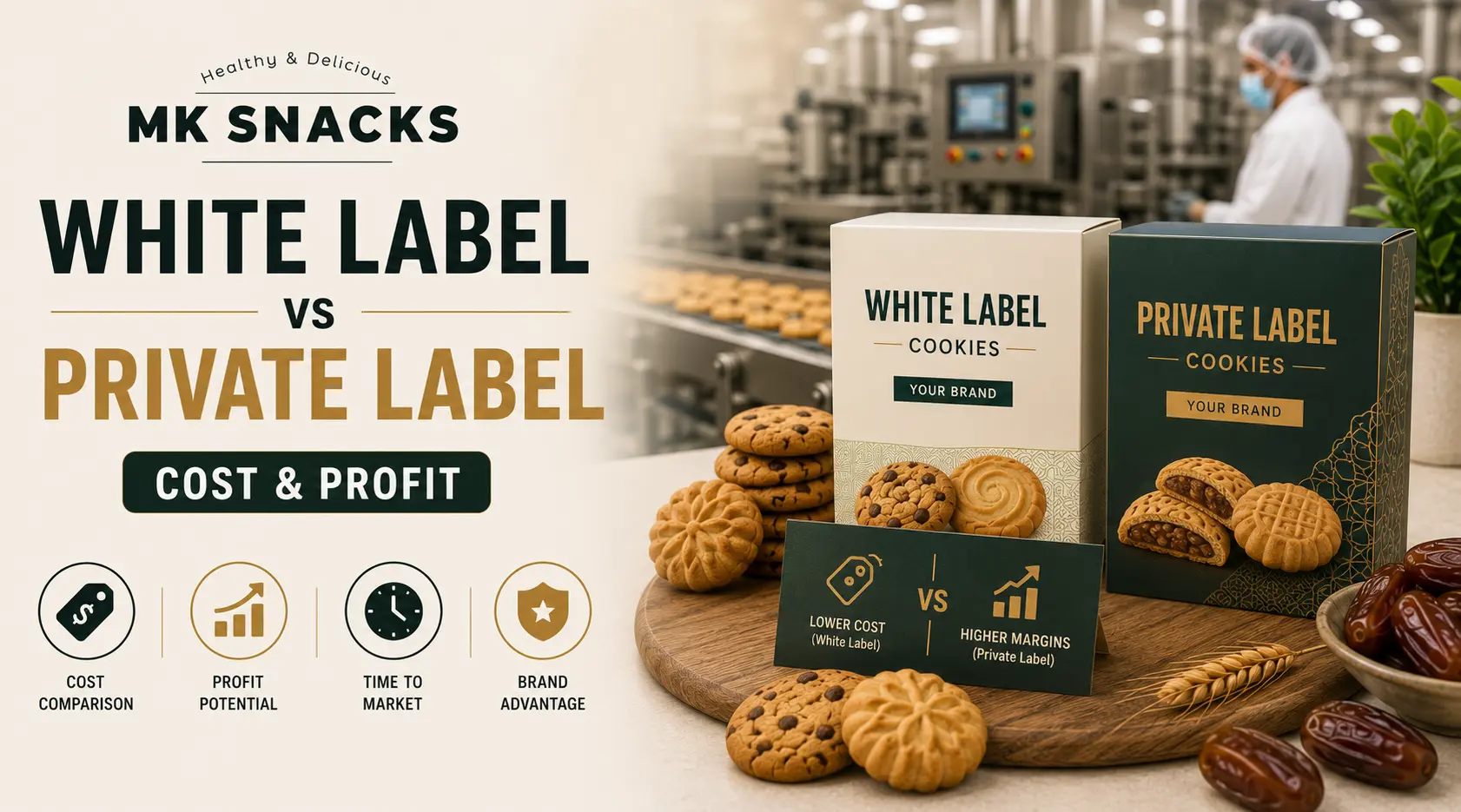
You want to sell branded cookies. But which path do you take: white label or private label? What costs more? Which launches faster? Which builds better long-term profit?
The answer depends on your business stage. White label costs less and launches in weeks. Private label takes longer but delivers higher margins and brand exclusivity.
This guide compares both models with real UAE manufacturing data so you choose correctly from day one.
At a Glance: Which Model Fits You?
| Need | Best Choice | Why |
| Launch in 2-3 weeks | White Label | Existing recipes, immediate production |
| Lowest startup cost | White Label | AED 2,000-5,000 vs AED 8,000+ |
| Unique recipe | Private Label | Only yours, not shared with competitors |
| Higher profit margins | Private Label | 70-85% vs 40-50% margins |
| Test market demand | White Label | Low risk, small MOQ (200-500 units) |
| Brand exclusivity | Private Label | Competitors can’t sell identical product |
| Retail chain placement | Private Label | Retailers demand unique products |
| Minimal investment risk | White Label | Smaller order quantities possible |
Quick Decision: Tight timeline and budget? Start white label. Building serious brand? Go private label. Testing first? Start white label, upgrade later.
What Is White Label Cookie Manufacturing?
White label means buying ready-made cookies from a manufacturer and adding your branding. The recipe is pre-established. The production line is running. You simply order, rebrand, and sell.
Think of it like buying wholesale products and putting your label on them. Except here, you’re the only one with your specific branding on that cookie.
How White Label Works in UAE Manufacturing
A Dubai or Abu Dhabi cookie manufacturer has perfected recipes over years. They produce the same cookie for multiple brands simultaneously. Each customer gets the same cookie with different packaging.
Typical Process:
- Browse available cookie recipes from the manufacturer Like MK Snack
- Choose one that fits your target market
- Design packaging with your logo and branding
- Order minimum quantity (usually 200-500 units)
- Receive branded, packaged cookies within 2-3 weeks
- Sell under your brand name
The manufacturer handles everything. You just rebrand and distribute.
Why White Label Launches Fast
Because the cookie already exists, there’s zero development time. No recipe testing. Not production setup. No customization delays.
Speed breakdown:
- Packaging design: 1 week
- Order placement: 1 day
- Production & shipping: 1-2 weeks
- Total: 2-3 weeks estimated
Compare this to private label’s 4-12 weeks, and the speed advantage is clear.
Benefits for Quick Market Entry
Test Demand Immediately: Launch with minimal investment. See if customers actually buy your branded cookies before committing heavily.
Low Financial Risk: If sales disappoint, you haven’t wasted AED 10,000+ on customization and certifications. Your downside is limited.
Easy Inventory Management: Need more stock? Order anytime. The recipe is perfected and ready to produce immediately.
Scalability Without Complexity: As demand grows, scale quantities without production delays or customization complications.
White label is ideal for retailers, small distributors, and entrepreneurs testing their brand’s viability.
What Is Private Label Cookie Manufacturing?
Private label means commissioning an exclusive recipe designed only for your brand. A Dubai or UAE snack manufacturer develops custom cookies specifically for you. The recipe, formula, and production process are yours alone.
This is manufacturing with complete control and ownership.
Custom Recipes & Full Branding Control
With private label, every element is yours:
Recipe Development: Your unique flavors, fillings, textures, and ingredients. The cookie is distinctive to your brand.
Packaging Design: Completely custom artwork, colors, messaging, and positioning. No shared designs with competitors.
Production Specifications: Your exact baking temperature, timing, appearance standards, and quality requirements.
Intellectual Property: The recipe and formula are yours. Competitors can’t replicate it exactly.
This level of control requires investment upfront but creates lasting competitive advantage.
Brand Differentiation Through Custom Manufacturing
Your private label cookies are genuinely different. A customer shopping at multiple retailers will only find your cookies at your store. This drives foot traffic and repeat purchases.
Long-term brand benefits:
- Customer loyalty to your unique product
- Premium pricing justified by exclusivity
- Retail shelf space defense against competitors
- Memorable brand identity
- Media/social proof advantage
Private label turns cookies from commodities into brand assets.
White Label vs Private Label: Complete Comparison
| Factor | White Label | Private Label |
| Recipe Customization | None – fixed recipe | Full – your custom recipe |
| Minimum Order (MOQ) | 200-500 units typical | 500-2,000 units typical |
| Cost Per Unit | AED 4-6 | AED 3-5 (volume dependent) |
| Initial Setup Investment | AED 1,500-3,000 | AED 5,000-8,000 |
| Time to Market | 2-3 weeks | 4-12 weeks |
| Packaging Customization | Your branding on standard box | Fully custom design |
| Recipe Exclusivity | Shared with other brands | Only yours |
| Wholesale Margin | 40-50% typical | 60-85% possible |
| Brand Differentiation | Limited (shared recipe) | High (unique product) |
| Production Flexibility | Lower – fixed recipes | Higher – custom specs |
| Reorder Flexibility | Unlimited – always available | Tied to your MOQ orders |
| Break-Even Timeline | 2-3 months | 4-6 months |
Which Is More Affordable?
White label is cheaper upfront. Initial investment is AED 2,000-3,000. You’re ready to sell within days.
Private label costs more initially. Full investment including design, customization, certifications, and first MOQ order runs AED 8,000-16,000.
But here’s the profit reality:
White label margins: 40-50%
- Sell at AED 20, cost is AED 10-12
- Profit per unit: AED 8-10
Private label margins: 70-85%
- Sell at AED 22-25, cost is AED 4-5
- Profit per unit: AED 17-20
After selling 500-1,000 units of private label, your total profit exceeds white label profitability even after accounting for higher setup costs.
Long-term verdict: Private label is more profitable despite higher upfront costs.
Which Model Launches Faster?
White label: 2-3 weeks guaranteed. Your cookies are on shelves within a month.
Private label: 6-12 weeks minimum. Recipe development (2-4 weeks), design approvals (2-3 weeks), certifications (4-8 weeks running parallel), production (1-2 weeks).
When speed matters: Emergency product launch, seasonal demand, competitive response. White label is only choice.
When quality matters more than speed: Building serious brand equity. Private label despite longer timeline.
Which Manufacturing Model Fits Your Business?
Best for Startups & First-Time Entrepreneurs
Start with white label. Minimize risk while testing market demand.
Why this works:
- AED 2,000-3,000 investment tests viability
- 2-3 week launch means faster learning
- Smaller MOQs reduce inventory risk
- See customer response before major investment
Typical progression:
- Months 1-3: White label test (low investment)
- Evaluate: Do customers want your branded cookies?
- If yes: Month 4-5, upgrade to private label (higher investment justified)
- If no: Pivot strategy without major losses
This two-stage approach converts risky entrepreneurship into validated business.
Best for Retail Chains & Supermarkets
Choose private label exclusively. Large retailers demand differentiation.
Why private label wins here:
- Exclusive products justify premium shelf space
- Unique recipe builds customer loyalty to your store
- Competitors can’t stock identical product
- Higher margins support retail operations
- Brand exclusivity drives store traffic
Major UAE retail chains (Carrefour, Lulu, Spinneys) prefer private label suppliers because it differentiates their own-brand offerings.
Best for Premium & Gourmet Snack Brands
Private label is mandatory. Premium positioning requires complete control.
Why this matters:
- Premium brands compete on uniqueness, not price
- Custom recipes justify AED 25-35+ retail prices
- Luxury packaging supports premium positioning
- Exclusivity protects brand image
- White label undermines premium perception
If your brand story emphasizes heritage, quality, or artisanal craftsmanship, white label commoditizes your positioning.
Best for E-Commerce & Direct-to-Consumer Brands
Private label recommended. Online brands compete on differentiation.
Why DTC favors private label:
- Unique product encourages repeat purchases
- Custom packaging enhances unboxing experience
- Exclusive recipe becomes marketing asset
- Social proof and reviews apply only to your product
- Competitive advantage sustainable
E-commerce success depends on creating products customers specifically seek out. White label struggles because customers can find the same product elsewhere.
Common Mistakes Brands Make When Choosing Manufacturing Models
Mistake #1: Choosing Private Label Too Early
The Problem: First-time entrepreneurs invest AED 10,000+ in private label before validating customer demand.
What Happens: If sales disappoint, you’ve wasted significant investment on customization and certifications. Worse, you’re stuck with 1,000+ units of slow-moving inventory.
Better Approach: Test with white label first. Spend AED 3,000, see if customers buy, then upgrade to private label when demand is proven.
Real Example: A Dubai entrepreneur invested AED 12,000 in private label cardamom cookies. First batch sold slowly. Had she tested with white label first (AED 2,500), she’d have learned demand was weak before major investment.
Mistake #2: Ignoring MOQ Realities
The Problem: Focusing only on unit cost without considering minimum order quantities.
What Happens: You think “AED 3 per unit sounds cheap!” but the MOQ is 2,000 units. That’s AED 6,000 upfront for inventory you might not sell quickly.
Better Approach: Calculate total investment, not just unit cost. A white label cookie at AED 5/unit with 300-unit MOQ (AED 1,500) beats private label at AED 3/unit with 2,000-unit MOQ (AED 6,000).
Real Example: A distributor chose a manufacturer based on “lowest per-unit cost” without checking MOQ. Ended up committing AED 8,000 to 2,000 units instead of AED 2,000 to 500 units with a competitor. The higher upfront cash flow nearly bankrupted the business.
Mistake #3: Underestimating Packaging Costs
The Problem: Focusing on cookie production cost while ignoring packaging expenses.
What Happens: You budget AED 4,000 for cookies but forget that custom packaging costs another AED 2,000-3,000. Total investment surprises you.
Better Approach: Always quote packaging separately. Request packaging costs upfront from manufacturers.
Real Example: Custom boxes (500 units) cost AED 1-3 each depending on complexity. A premium design with foil stamping costs AED 3/box. 500 boxes = AED 1,500 additional investment not initially budgeted.
Mistake #4: Selecting Based Only on Unit Price
The Problem: Choosing the manufacturer with the cheapest per-unit cost.
What Happens: Lower cost doesn’t mean lower total cost. Cheap suppliers often have:
- Higher MOQ requirements
- Longer lead times
- Quality inconsistencies
- Less customization flexibility
- Weak certifications
Better Approach: Compare total investment, timeline, and quality. Not just unit price.
Real Example: Manufacturer A: AED 4/unit, 2,000 MOQ, 6-week lead time. Manufacturer B: AED 5/unit, 500 MOQ, 2-week lead time. Manufacturer A seems cheaper (AED 8,000 vs AED 2,500), but if you only need 500 units, Manufacturer B at AED 2,500 is actual cheaper choice.
Mistake #5: Ignoring Halal Certification Timeline
The Problem: Assuming halal certification happens automatically or quickly.
What Happens: Certification takes 4-8 weeks. If not planned, you miss launch dates. UAE market demands halal certification for retail.
Better Approach: Factor certification timeline into your launch plan. Start process early. Some certifications run parallel to production.
Real Example: A brand planned 6-week private label launch without including certification time. Cookies finished in week 6, but halal certification wasn’t approved until week 10. Retail placement missed.
Why Choose MK Snacks for White Label or Private Label in UAE
MK Snacks operates as both white label supplier and private label partner. We support entrepreneurs at every stage.
White Label Expertise
We produce established maamoul and cookie recipes perfected over 10+ years. These are proven products with established quality standards.
White label advantages with us:
- Fast 2-3 week turnaround
- Affordable AED 2,000-3,000 entry point
- Halal-certified recipes (ready to go)
- Flexible MOQ (start at 300 units)
- Packaging support included
Private Label Customization
We develop custom recipes specifically for your brand. Whether you want traditional Middle Eastern flavors or unique global tastes, we create exactly what you envision.
Private label services include:
- Recipe development & customization
- Packaging design support
- Compliance & certification guidance
- Halal ESMA certification facilitation
- Export documentation support
UAE Manufacturing Advantage
Located in UAE, we understand local regulations, halal requirements, and GCC market dynamics. We handle:
- Halal ESMA certification (Emirates Authority for Standardisation & Metrology)
- UAE food safety compliance
- GCC export documentation
- Supermarket retailer requirements
- E-commerce packaging standards
Real Production Capabilities
Our facility produces 2,000-5,000 cookies daily with capacity for both white label and private label orders. We’ve worked with retailers, distributors, and e-commerce brands across UAE and GCC.
FAQs: White Label vs Private Label
What’s the main difference between white label and private label cookies?
White label uses the manufacturer’s existing recipe. You just rebrand it. Private label creates an exclusive recipe designed only for your brand. White label is faster and cheaper. Private label offers complete control and higher margins.
Can I customize white label cookies?
Minimal customization only. You can’t change the recipe or cookie type. You can customize packaging with your branding. Some manufacturers offer flavor variations within existing recipes (chocolate vs vanilla).
Which is cheaper, white label or private label?
White label is cheaper initially (AED 2,000-3,000 investment). Private label costs more upfront (AED 8,000-16,000). But private label has higher profit margins, making it more profitable long-term.
Can I switch from white label to private label later?
Absolutely. Many brands start white label to test demand, then upgrade to private label once sales justify investment. This is a smart, proven strategy.