


Food Production Standards Every UAE Snack Manufacturer Should Follow

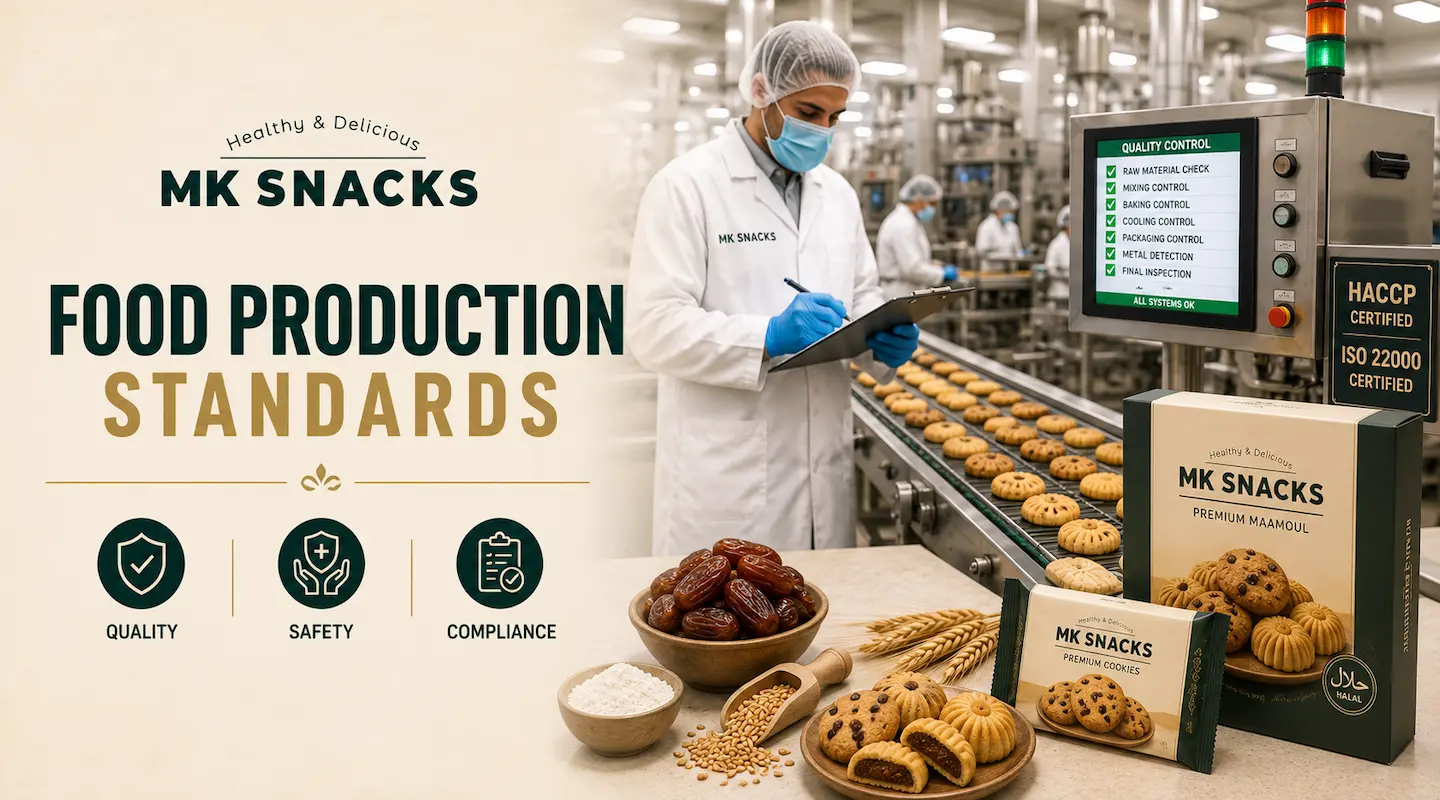
Walk into any supermarket in Dubai or Abu Dhabi and you will find hundreds of snack options competing for attention. But behind every product that earns a spot on those shelves, there is a set of food production standards that made it possible.
Food production quality directly shapes what consumers eat, how long products last, and whether manufacturers keep or lose retail partnerships. For any snacks manufacturer UAE, meeting these standards is not optional. It is the price of entry into a market that is growing faster than almost anywhere else in the region.
At MK Snacks, food production standards are treated as the backbone of every manufacturing decision, not a compliance checklist to revisit once a year.
What Are Food Production Standards?
Food production standards are a structured set of quality, safety, hygiene, and operational requirements that food manufacturers are expected to follow. They exist to ensure that every product leaving a facility is safe, consistent, and fit for consumption.
These standards cover everything from how raw materials are received and stored to how finished products are labeled, packaged, and distributed.
The Role of Standards in Snack Manufacturing
In snack manufacturing, standards play an especially critical role because products are produced at high volumes with tight margins for error. A single ingredient issue or a lapse in hygiene can affect thousands of units before it is detected.
Reliable snack manufacturing depends on systems, not luck. When the right standards are in place, quality becomes repeatable rather than accidental.
Understanding UAE Food Safety Requirements
The UAE operates one of the most structured food safety regulatory environments in the Middle East. Manufacturers are expected to comply with federal legislation, municipal codes, and regional Gulf standards simultaneously.
Key regulatory frameworks include the UAE Federal Law on Food Safety, the Dubai Municipality Food Code, and standards issued by the Gulf Standardization Organization (GSO), which govern everything from labeling requirements to permissible additives.
Why Food Safety Standards UAE Matter
Food safety standards UAE compliance is not just about avoiding penalties. It is what allows a manufacturer to access retail shelves, secure export licenses, and build long-term trust with distributors and buyers across the GCC.
Non-compliance, even in minor areas, can result in product recalls, loss of business licenses, or damage to brand reputation that takes years to repair.
Implementing HACCP and ISO 22000 in Food Production
HACCP, which stands for Hazard Analysis and Critical Control Points, is the globally recognized framework for identifying and controlling food safety risks before they reach consumers. It is built around prevention rather than reaction.
In practice, HACCP requires manufacturers to map every stage of production, identify where biological, chemical, or physical hazards could occur, and put control measures in place at those critical points.
Building a Preventive Food Safety Culture
ISO 22000 takes HACCP further by embedding food safety management into the entire organization. It connects production controls, supplier management, staff training, and documentation into one integrated system.
Together, HACCP and ISO 22000 create a culture where food safety is managed proactively rather than addressed after problems occur. For a closer look at how certified manufacturing works in practice, read our guide on how cookies are made by a cookie manufacturer in UAE.
Supplier Verification and Ingredient Quality Control
A finished snack product can only be as good as the ingredients that went into it. That is why supplier verification is one of the most important and most underestimated areas of food production standards.
Approved supplier programs require manufacturers to assess, qualify, and regularly audit every raw material source. Ingredients are tested for purity, moisture, microbiological safety, and compliance with permitted food-grade specifications before they are accepted into production.
Building Quality From the First Ingredient
Ingredient traceability systems ensure that every batch of raw material can be tracked back to its origin. If a quality issue is identified in a finished product, traceability allows manufacturers to isolate the source quickly and take corrective action before more product is affected.
Brands sourcing in volume benefit most from this level of transparency. If you are planning to buy in bulk, see our complete guide on how to buy bulk maamoul wholesale in UAE to understand what verified sourcing looks like in practice.
Production Controls That Maintain Consistent Snack Quality
Even with quality ingredients and strong supplier verification, consistency can still break down on the production floor. That is where production controls become essential.
Mixing times, temperatures, moisture levels, dough weight, and bake profiles are all monitored and recorded throughout the production process. Any variation outside the accepted tolerance triggers an immediate review.
Why Process Control Matters in Snack Manufacturing
Batch consistency is what separates a trusted manufacturer from one that delivers unpredictable results. Retailers and distributors need to know that every order they receive will perform exactly like the last one.
Modern snack manufacturing facilities use automated monitoring systems that track process parameters in real time, reducing the reliance on operator judgment alone and creating a documented record for every production run.
Quality Assurance Throughout the Production Process
Quality assurance in food production is not a single inspection at the end of the line. It is an ongoing system that runs in parallel with every stage of manufacturing.
In-process checks monitor weight, dimensions, color, texture, and filling ratios at regular intervals. Finished products are tested against specification before any batch is cleared for packaging and release.
Preventing Quality Issues Before They Reach Consumers
The goal of a well-designed quality control process is to catch problems as early as possible. An issue identified during mixing is far cheaper to correct than one that is discovered after packaging is complete.
Brands launching their own product line need this level of assurance from day one. Learn how MK Snacks supports new launches through our private label cookies program.
Packaging Standards for Food Safety and Shelf Life
Packaging is the final line of defense between a quality product and the consumer. It is also one of the most regulated areas of food production in the UAE.
All packaging materials used in food contact applications must be food-grade certified and appropriate for the specific product being packed. Moisture barriers, oxygen transmission rates, and seal integrity all directly affect how long a product remains fresh and safe.
Protecting Product Quality After Production
GSO labeling requirements mandate that products sold across GCC markets carry accurate ingredient declarations, allergen information, country of origin, production dates, and expiry dates in both Arabic and English.
Allergen management is a particularly critical area. Cross-contamination risks must be controlled and clearly communicated through packaging to protect consumers and meet the legal requirements of every market served.
Food Production With Standards vs Poor Manufacturing Practices
The difference between standardized production and poor manufacturing practices is visible in every measurable outcome.
| Area | Standardized Production | Poor Manufacturing Practices |
| Food Safety | High and consistent | Inconsistent and risky |
| Product Quality | Reliable batch to batch | Variable and unpredictable |
| Regulatory Compliance | Verified and documented | At risk of violations |
| Shelf Life | Reliable and controlled | Unpredictable |
| Consumer Trust | Strong and sustainable | Weak and easily damaged |
| Recall Risk | Significantly reduced | Elevated |
The gap is not just operational. It is commercial. Retailers, distributors, and private label buyers consistently prefer to work with manufacturers whose standards are documented, audited, and proven.
How MK Snacks Maintains High Food Production Standards in UAE
MK Snacks was built on the understanding that quality is not a marketing message. It is a production outcome.
As a dedicated maamoul manufacturer UAE and broader healthy snack manufacturer UAE, MK Snacks operates production systems designed to meet the full requirements of UAE food safety law, GCC export standards, and international buyer expectations.
The food production framework at MK Snacks includes:
- Verified and approved raw material sourcing with full ingredient traceability
- HACCP-aligned production controls at every critical stage
- ISO 22000 food safety management across the full operation
- In-process and finished product quality control testing
- GSO-compliant packaging and allergen management systems
- Documented batch records for full production traceability
- Continuous improvement programs driven by data and corrective actions
Every maamoul and cookie that leaves the facility has passed through a system designed to deliver the same quality every single time.
Choosing a Reliable Snack Manufacturer in UAE
Selecting a manufacturing partner is one of the most important decisions a food brand or distributor will make. The wrong choice creates quality problems, compliance risks, and supply chain disruptions that are costly and time-consuming to resolve.
When evaluating a snacks manufacturer UAE, buyers should focus on the following criteria:
Certifications and Compliance Look for HACCP, ISO 22000, GMP, and HALAL certification as a minimum standard. Verify that certifications are current and issued by recognized bodies.
Production Capabilities Confirm the manufacturer has the equipment, capacity, and technical expertise to handle your product format and required volume.
Quality Management Systems Ask how quality is monitored during production, not just at the end. A manufacturer who can only show you finished product inspection data is missing most of the picture.
Transparency and Traceability A trustworthy partner can trace every ingredient in every batch back to its source. If that information is not available, that is a warning sign.
Manufacturing Expertise Experience with your specific product category matters. If you are deciding between white label and private label options, our detailed white label vs private label cookies comparison breaks down the cost, MOQ, and profit differences to help you choose the right model.
To discuss your manufacturing requirements directly, partner with MK Snacks and connect with a team that meets all of these criteria.
Conclusion
Food production standards exist because quality does not happen by accident at scale. They are the systems, processes, and verified controls that allow manufacturers to deliver safe, consistent, and compliant products to consumers across the UAE and GCC markets.
For brands and buyers, the choice of manufacturing partner is inseparable from the choice of standards. A manufacturer without robust systems is a liability, regardless of how competitive their pricing may appear.
If you are looking for a trusted halal cookie manufacturer UAE and snacks manufacturer UAE with verified food safety credentials and proven production expertise, visit MK Snacks and take the first step toward a stronger supply partnership.
Frequently Asked Questions
What are food production standards?
Food production standards are a set of quality, safety, hygiene, and operational requirements that food manufacturers follow to ensure their products are safe, consistent, compliant, and suitable for consumers. They cover every stage of production from ingredient sourcing through to packaging and distribution.
Why is HACCP important in food manufacturing?
HACCP is important because it takes a preventive approach to food safety. Rather than inspecting for problems after they occur, HACCP requires manufacturers to identify hazard points in the production process and put controls in place before products are affected.
What food safety standards apply in UAE?
Food manufacturers operating in the UAE are required to comply with the UAE Federal Food Safety Law, the Dubai Municipality Food Code, and Gulf Standardization Organization requirements. HACCP and ISO 22000 certification are also expected by most retail buyers and export markets.
How do snack manufacturers ensure product quality?
Quality is maintained through a combination of approved supplier programs, in-process production controls, finished product testing, HACCP compliance, and documented batch records. Leading manufacturers use automated monitoring systems to track critical parameters throughout every production run.
What is the difference between HACCP and ISO 22000?
HACCP is a specific food safety methodology focused on identifying and controlling hazards at critical points in the production process. ISO 22000 is a broader food safety management system standard that incorporates HACCP principles and extends them across the entire organization, including supplier management, staff training, and documentation systems.
Why is ingredient traceability important in food production?
Ingredient traceability allows manufacturers to track every raw material from its source through to the finished product. If a quality or safety issue is identified, traceability systems allow the affected batches to be isolated quickly, reducing the scope of any potential recall and protecting consumers.