


How Cookies Are Made: Complete Manufacturing Process Explained

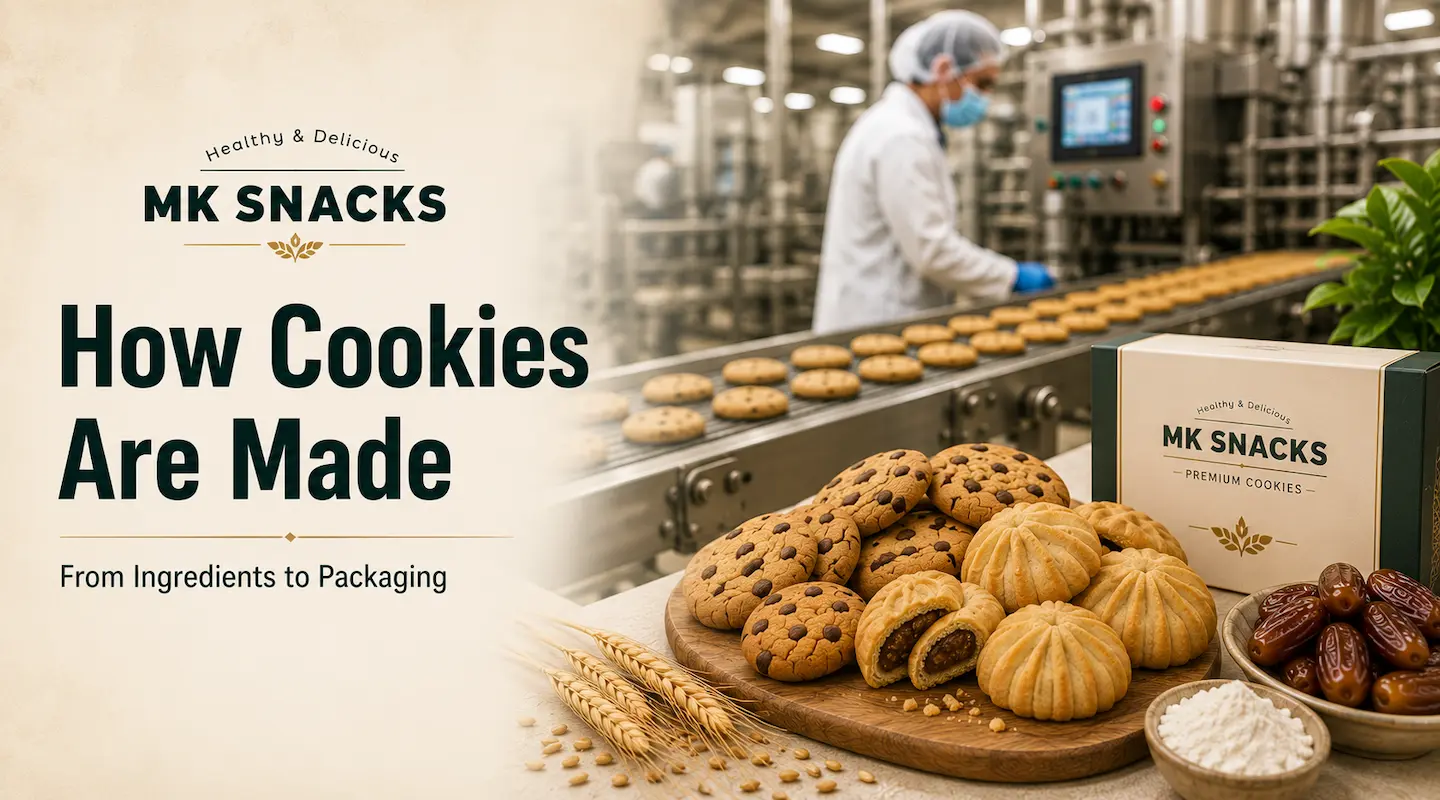
Every cookie on a shelf has a story. It starts long before the wrapper, in a facility where precision, ingredients, and technology come together at scale.
As a trusted cookie manufacturer UAE, MK Snacks understands that great cookies are not made by chance. They are built through a repeatable, quality-driven process that begins with raw materials and ends with a perfectly sealed product ready for shelves across the GCC.
This guide walks you through every step of that process, from ingredient selection to final packaging, and explains what separates a reliable snack manufacturing company from the rest.
What Is the Cookie Manufacturing Process?
The cookie manufacturing process is a series of carefully controlled steps that transform raw ingredients into consistent, shelf-stable baked products. Every stage is monitored for quality, safety, and efficiency.
Here is a quick overview of the full journey:
| Step | Stage |
| 1 | Ingredient Selection |
| 2 | Dough Mixing and Preparation |
| 3 | Shaping and Forming |
| 4 | Baking |
| 5 | Cooling and Stabilization |
| 6 | Quality Control and Food Safety Testing |
| 7 | Packaging and Distribution |
From Raw Ingredients to Finished Packaging
Each stage builds on the last. A mistake early in the process, like an inconsistent dough mix, will show up later as an uneven bake or a broken texture. That is why industrial cookie manufacturing demands precision at every single point.
Step 1: Selecting High-Quality Ingredients
The quality of a finished cookie is largely decided before the oven is even turned on. Ingredient selection is the foundation of every reliable cookie production process.
Leading manufacturers source flour, dates, sweeteners, vegetable fats, natural flavors, and functional additives from approved, tested suppliers. Ingredients are checked for moisture content, purity, and compliance with food safety standards before they are accepted into the facility.
Why Ingredient Quality Matters
Poor-quality raw materials lead to inconsistent batches, shorter shelf life, and failed quality checks. A serious cookie manufacturing company treats supplier qualification as seriously as production itself.
At MK Snacks, ingredient sourcing is treated as the first quality checkpoint, not an afterthought.
Step 2: Dough Mixing and Preparation
Once ingredients are approved, dough preparation begins. This stage is where the recipe comes to life, and consistency is everything.
Industrial mixing systems combine dry and wet ingredients at controlled speeds and temperatures. The result is a uniform dough with the right texture, moisture level, and structure for forming.
How Manufacturers Maintain Batch Consistency
Batch consistency is achieved through precise formulations, calibrated mixing times, and automated weight measurements. Even small deviations in water content or mixing speed can affect the final product texture.
Modern commercial cookie manufacturing relies on programmable mixing equipment that follows exact parameters for every batch, removing guesswork entirely.
Step 3: Shaping and Forming the Cookies
Once the dough is ready, it moves to the forming stage. This is where cookies get their shape, size, and in many cases, their filling.
Automated forming equipment handles everything from rotary moulding to wire cutting and extrusion. The type of equipment used depends on the cookie variety being produced.
How Maamoul Cookies Are Formed
Maamoul manufacturing is a specialized process that requires careful attention to the date filling. The dough is shaped around a measured portion of date paste, then pressed into a mould that creates the distinctive textured exterior.
As an experienced maamoul manufacturer, MK Snacks uses precision forming systems that maintain the right dough-to-filling ratio across every single piece. Explore our maamoul products to see the result of that process.
Step 4: Baking for Consistent Quality
Baking is where raw dough becomes a finished cookie. But in industrial cookie manufacturing, the oven is not simply turned on and left to run.
Temperature, humidity, conveyor speed, and airflow are all controlled throughout the bake cycle. These variables are tuned to the specific recipe and product format being produced.
The Role of Baking Technology in Snack Manufacturing
Modern baking technology uses tunnel ovens with multiple independently controlled zones. Each zone can be set to a different temperature, allowing precise control over how heat penetrates the cookie from bottom, top, and sides.
This level of control is what allows a snack manufacturer UAE to produce a cookie that tastes exactly the same in every batch, every time.
Step 5: Cooling and Product Stabilization
After baking, cookies are hot, fragile, and high in moisture. They cannot be packaged immediately or the packaging will trap steam and destroy shelf life.
Cooling conveyors carry baked cookies through a controlled airflow environment that gradually reduces their temperature. This step also allows internal moisture to stabilize, which directly affects texture and crispness.
Rushing this stage is one of the most common reasons cookies turn soft or become damaged during packaging. Proper cooling is a non-negotiable part of professional cookie production process management.
Step 6: Quality Control and Food Safety Testing
Quality control is not a single checkpoint. It runs throughout the entire cookie production line, from incoming ingredients to outgoing finished goods.
In-process inspections check for weight, dimensions, color, texture, and filling ratio at regular intervals. Any deviation triggers an immediate review and, if necessary, a production hold.
Certifications Every Reliable Cookie Manufacturer UAE Should Follow
A serious cookie manufacturer UAE operates under internationally recognized food safety frameworks. Key certifications include:
- HACCP (Hazard Analysis and Critical Control Points)
- ISO 22000 Food Safety Management
- GMP (Good Manufacturing Practices)
- HALAL Certification for GCC market compliance
These certifications are not just about compliance. They are a signal to buyers, retailers, and consumers that the manufacturing environment is safe, consistent, and trustworthy. At MK Snacks, food safety is embedded into every stage of production.
Step 7: Packaging and Distribution
The final step in the cookie manufacturing process is packaging. At this stage, manufacturers protect the product, strengthen brand presentation, and prepare cookies for distribution to retail shelves, wholesale buyers, and export markets.
To maintain freshness, protective packaging systems seal cookies in moisture-resistant, food-grade materials that help extend shelf life and preserve product quality.
Once packaging is complete, products move through carefully managed distribution channels. As a result, leading food production and snack manufacturing companies in the UAE can efficiently supply local retailers, regional supermarket chains, international markets, and private label clients that require customized packaging solutions.
Manual vs Automated Cookie Manufacturing
Understanding the difference helps buyers make better decisions when choosing a manufacturing partner.
| Factor | Manual Production | Automated Production |
| Batch Consistency | Variable | High |
| Output Volume | Limited | Scalable |
| Quality Control | Operator-dependent | Standardized |
| Hygiene Control | Harder to maintain | Easier to control |
| Production Speed | Slower | Faster |
| Cost Efficiency | Lower at scale | Higher at scale |
Automated production does not replace skill. It standardizes it. Human expertise goes into recipe development, equipment calibration, and quality oversight. Automation handles the repetitive physical tasks that introduce inconsistency when done by hand.
For any serious wholesale cookie manufacturer or private label partner, automated production is the baseline expectation, not a premium feature.
How MK Snacks Delivers High-Quality Cookie Manufacturing in UAE
MK Snacks is built around one goal: producing consistently excellent baked snacks that meet the standards of modern retail and export markets.
As a specialist maamoul manufacturer and broader snack manufacturing company, MK Snacks combines traditional recipes with modern production methods. The result is a product range that carries authentic flavor and industrial-grade consistency.
The manufacturing approach at MK Snacks covers:
- Controlled raw material sourcing from approved suppliers
- Automated dough mixing and forming for batch-to-batch consistency
- Precision baking technology with multi-zone tunnel ovens
- Rigorous quality assurance at every production stage
- HACCP-aligned food safety procedures
- Retail-ready packaging systems for local and export markets
Choosing the Right Cookie Manufacturer in UAE
Not every cookie factory UAE operates at the same standard. When evaluating manufacturing partners, buyers should assess the following:
Production Capabilities Can the manufacturer handle your required volume? Do they have the equipment for your specific product format?
Quality Certifications Look for HACCP, ISO 22000, GMP, and HALAL compliance at a minimum.
Ingredient Sourcing Transparency A trustworthy partner can tell you where their ingredients come from and what quality checks are applied.
Product Consistency Ask about batch-to-batch variation and how it is controlled on the production line.
Innovation and Customization Can the manufacturer develop new recipes or adapt existing products for your market? This matters for private label cookies UAE and custom product development.
Visiting MK Snacks is a good starting point for any brand or buyer looking for a reliable, certified partner in the UAE and GCC region.
Conclusion
The cookie manufacturing process is far more complex than most people imagine. It is a carefully engineered sequence of steps, each one dependent on the last, all working together to produce a product that is safe, consistent, and genuinely good.
From ingredient sourcing to cooling conveyors to quality inspections, every detail matters. And in a competitive market like the UAE and GCC, the manufacturers who get those details right are the ones whose products earn a permanent place on store shelves.
If you are looking for a dependable cookie manufacturer UAE with proven expertise in maamoul, date-filled cookies, and baked snack production, explore MK Snacks and connect with our team today.
Frequently Asked Questions
How are cookies made in a manufacturing facility?
Cookies are produced through a multi-step industrial process. It begins with ingredient selection and dough preparation, moves through shaping, baking, and cooling, and ends with quality inspection and packaging. Every stage is controlled to ensure consistency and food safety.
What equipment is used in cookie manufacturing?
Commercial cookie production relies on industrial mixing systems, rotary moulders or wire-cut forming machines, tunnel ovens, cooling conveyors, and automated packaging lines. The specific equipment varies depending on the cookie type and production volume.
What certifications should a cookie manufacturer in UAE have?
A reliable cookie manufacturer UAE should hold HACCP certification, ISO 22000 Food Safety Management certification, Good Manufacturing Practices (GMP) compliance, and HALAL certification, which is essential for the GCC market.
How is the maamoul manufacturing process different from regular cookies?
Maamoul production requires specialized forming equipment that shapes dough around a precise portion of date or nut filling and presses it into a decorative mould. The dough-to-filling ratio and mould design are critical to the final product quality.
Why choose a UAE-based cookie manufacturer?
UAE-based manufacturers offer geographic proximity to GCC markets, faster lead times, and familiarity with regional consumer preferences and regulatory requirements. Local production also reduces import costs and logistics complexity for regional buyers.